
Prompt injection & jailbreaks
Malicious instructions ride inside ordinary prompts and tool output, bending models away from your intent.
One intelligent proxy layer between your applications and AI services. Get real-time monitoring, policy enforcement, and threat detection for LLM APIs, MCP servers, and A2A agents, with complete visibility over every request.
The first full release closes the beta series. Every subsystem was re-audited, exercised end to end, and wired into the dashboards, audit trail, and alerting pipeline before it shipped, and the proxy layer stepped up to the newest MCP specification without dropping the old one.
Both MCP spec eras proxied side by side, with conformance enforcement, a compatibility bridge so modern clients still reach legacy servers, and an alert on every protocol downgrade.
XAA now tracks IETF ID-JAG draft-04 and is verified against the xaa.dev reference implementation: single-use grants, signed audience-bound tokens, and RFC 9470 step-up. Experimental
Multi-pass backend review: fail-closed policy loading, skill guards, and tool-permission checks; SSRF guards on every outbound dial; body-size limits and LIKE-wildcard escaping across handlers.
Server-side logout via JTI blacklist, instant session invalidation on role change, admin session management, forced password rotation, login rate limits, and a timing-oracle fix.
Guardrail provider credentials, evaluation endpoint secrets, and inventory connector auth headers are encrypted at rest and masked in every API response.
RFC 9449 end to end. Proofs must be self-signed, match the pinned thumbprint, bind to the live request, stay fresh, and carry a single-use jti checked against a replay cache.
LLMs, MCP servers, and autonomous agents now touch real data and real systems, often with no proxy, no policy, and no audit trail. The gateway puts a single, inspectable control point in front of all of it.
Malicious instructions ride inside ordinary prompts and tool output, bending models away from your intent.
Models, tools, and agents get wired in without anyone sanctioning them, invisible until something goes wrong.
Token spend compounds quietly across teams and keys with no budget, no threshold, and no way to cut it off.
MCP tools and A2A agents can silently change behaviour or redirect traffic after you've already trusted them.
Same gateway either way. What you set up first is the part that differs.
Know what AI is actually running, enforce a control that genuinely blocks, prove it works against a named framework, and produce the evidence.
Start hereOne process to deploy, a latency budget it respects, blast-radius control when a provider misbehaves, and metrics without writing instrumentation first.
Start hereClient auth that configures itself, tools scoped to what the agent actually calls, PII kept out of the provider, and a spend limit that stops a runaway loop.
Start hereThe gateway sits inline as a proxy. Every request is inspected, scored, and either forwarded, redacted, or blocked, then logged with full attribution.
Create an MCP or LLM proxy and point Claude Desktop, Cursor, or your own app at it. OAuth 2.1 with Dynamic Client Registration means most clients connect with zero configuration.
Each request runs the policy engine, third-party guardrail providers, agent-identity verification, budget checks, and PII redaction, all concurrently, so latency tracks the slowest check rather than the sum.
Clean traffic is forwarded to the target AI service. Threats are blocked in real time, sensitive data is masked before it leaves, and shadow or quarantined assets are denied at the proxy.
Watch it live on the dashboard, stream traces to Langfuse / Prometheus / OpenTelemetry, and keep a complete audit trail tied to both the human and the verified agent behind every action.
Every stage runs concurrently, so latency tracks the slowest check, not the sum of all of them.
A real-time Vue interface ships inside the binary, with no separate install.
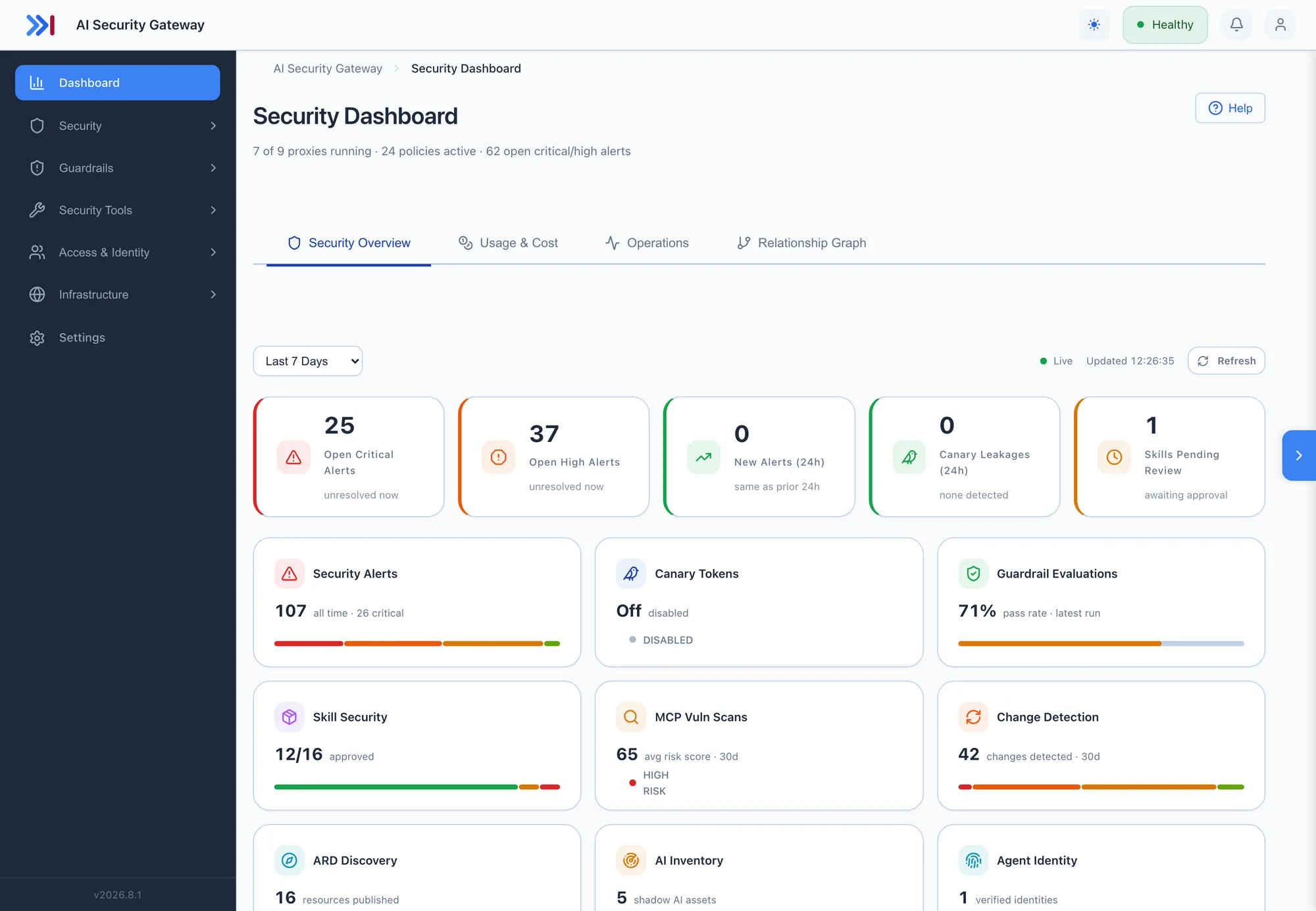
A deep capability set across five pillars, from threat detection and cryptographic agent identity to cost governance, observability, and operations.
213 JSON-defined rules, holding 1,100+ patterns across 15 policy packs and 8 compliance templates, catch injection, path traversal, prompt injection, and jailbreaks, graded by severity and assigned per proxy in priority order.
Learn moreMask PII, secrets, and sensitive content before it reaches the provider, then automatically restore the original values in the response, seamless for the end user.
Learn moreFan out to Groq Safeguard, EnkryptAI, DynamoAI, GuardrailsAI, and Fiddler concurrently. Per-proxy or per-team, with fail-open/closed modes and a test playground.
Learn moreAutomated penetration testing for your AI safety controls: 85 built-in cases across 14 attack categories, scored against OWASP LLM Top 10 and NIST AI RMF, including multi-turn escalation. Author your own cases and import/export suites as JSON.
Learn moreRuntime security analysis of live MCP endpoints: tool-permission auditing, API-surface assessment, and malicious-payload detection wired into the policy engine.
Learn moreA tripwire for data leakage. It detects when a canary from 1 user or session surfaces in another, plus provider memorization and stale-canary signals.
Learn moreRFC 7591 Dynamic Client Registration with RFC 8414 discovery and full PKCE. Upstream pass-through or full gateway authorization-server mode. Cursor and Claude Desktop work out of the box.
Learn moreVerify the agent workload itself: SPIFFE JWT-SVIDs & X.509-SVIDs (mTLS) and DIDs (did:key / did:web). Deny-biased per-agent tool rules, autonomy floors, and DPoP step-up.
Learn moreVerifiable on-behalf-of delegation chains with a confused-deputy guard. Revoking an identity tears down its live A2A streams and SSE connections within seconds.
Learn moreOAuth tokens and API keys work side by side on the same proxy. Every request is attributed to a user identity, email, timestamp, and risk score.
Learn moreAdmin / user / viewer roles with resource-ownership checks, plus per-user and per-tool sliding-window rate limits keyed down to user · proxy · tool.
Learn moreIdentity Assertion Authorization Grants let an IdP such as Okta authorize 1 app's agent to reach another app's MCP server. Single-use grants, signed audience-bound tokens, verified against the xaa.dev reference. Experimental
Learn moreA governed inventory of every AI asset the gateway sees (providers, models, MCP tools, A2A agents, skills) that auto-flags anything observed but never sanctioned.
Learn moreMove an asset to quarantined or denied and it's blocked at the proxy on its next request, whether that is an MCP tool, an LLM model, or an entire provider, via a live denylist.
Publish a standards-compliant /.well-known/ai-catalog.json and answer "what's available for this task?" via search, explore, and federation. It is the discovery layer in front of A2A, MCP, and skills.
Auto-discover agents via AgentCard URLs, invoke them with streaming responses, and track stateful tasks through their lifecycle, with every call scored by the policy engine.
Learn moreContinuously watch MCP tools and A2A AgentCards for silent changes: URL redirects, dropped skills, and capability flips, with severity scaled to how much changed.
Learn moreA full MCP server that assistants connect to directly. Submit skill source for content-addressable approval (any change resets to pending) and report suspicious runtime behaviour.
Learn moreMonthly USD limits per team or API key with configurable warning thresholds. Choose to warn or hard-block at the limit, where exceeded requests get an HTTP 402.
Learn moreMonitor input/output tokens, cost, and usage patterns per proxy and per model, surfaced in the AI Usage Metrics dashboard.
Learn moreA live dashboard of request rates, error rates, and security alerts, pushed over WebSocket with no polling. Advanced alert filtering and status workflow included.
Learn moreSend LLM traces to Langfuse, expose native Prometheus metrics, visualize in Grafana, and emit OpenTelemetry / Jaeger spans with p50/p95/p99 percentiles.
Learn moreAutomatically inject security controls and behavioural guidelines into LLM requests, priority-selected per proxy or user group, with template variables and audit logging.
Learn moreSend alerts where your team already watches: SIEM, SOAR, Slack, email over SMTP, and webhooks, each with its own severity threshold.
Learn moreRun unlimited MCP and LLM proxy instances side by side. Create, configure, start, stop, and restart each from 1 dashboard, over HTTP, WebSocket, or SSE.
Learn moreA Vue 3 dashboard with real-time status, an interactive alerts view, a visual policy editor, usage analytics, and full light/dark theming, responsive on desktop and mobile.
Learn moreTools are discovered automatically but disabled by default. A 3-tier permission hierarchy (user override > group > global) decides exactly what each caller can invoke.
Learn moreA pre-built Go binary for Linux, macOS, and Windows, with no Docker required for the API server. Configurations, alerts, and logs persist in SQLite via GORM.
Learn moreAuth events, authorization failures, data changes, config changes, and security events are all logged, built for SOC 2, ISO 27001, HIPAA, and GDPR evidence.
Learn moreThanks to OAuth DCR and well-known discovery endpoints, MCP clients like Cursor IDE and Claude Desktop authenticate and start working without manual setup.
Learn moreReplicate audit logs, alerts, and token usage to an external RDS database (PostgreSQL or MySQL) for long-term retention, via real-time, batch, or hybrid sync.
Learn moreSchedule database snapshots from hourly to weekly with compression and a retention cap, browse every backup, and restore in 1 click from the Settings dashboard.
Learn moreThe gateway sits inline, so it has to inspect every byte and never become the reason a request is slow. It is a single Go executable with no interpreter to install and no runtime to patch separately from the application.
Grab a pre-built release for your OS, generate two secrets, and start the gateway.
The dashboard comes up on localhost:8080.
# 1 · Download and extract the latest release
curl -LO https://github.com/syphon1c/ai-security-gateway/releases/latest/download/unified-admin-linux-amd64.tar.gz
tar -xzf unified-admin-linux-amd64.tar.gz
cd unified-admin-linux-amd64

# 2 · Run the installer (generates JWT + encryption keys)
chmod +x install.sh verify.sh start.sh
./install.sh

# 3 · Start the gateway → http://localhost:8080
./start.sh# 1 · Extract unified-admin-windows-amd64.zip, then:
cd unified-admin-windows-amd64
# 2 · Copy the env template and set your keys
Copy-Item env.example .env
notepad .env # set JWT_SECRET and ENCRYPTION_KEY
# 3 · Start the gateway
.\start.ps1The start script prints a one-time admin password on first run. Save it, then change it after logging in. Full steps in the installation guide.
Self-hosted and yours to run. Download v2026.8.1, point your clients at it, and see every request your AI stack makes.